Node Readiness Controller
A Kubernetes controller that provides fine-grained, declarative readiness for nodes. It ensures nodes only accept workloads when all required components (e.g., network agents, GPU drivers, storage drivers, or custom health-checks) are fully ready on the node.
Use it to orchestrate complex bootstrap steps in your node-init workflow, enforce node health, and improve workload reliability.
What is Node Readiness Controller?
The Node Readiness Controller extends Kubernetes’ node readiness model by allowing you to define additional pre-requisites for nodes (as readiness rules) based on node conditions. It automatically manages node taints to prevent scheduling until all specified conditions are satisfied.
Why This Project?
Kubernetes nodes have a simple “Ready” condition. Modern workloads need more critical infrastructure dependencies before they can run.
With this controller you can:
- Define custom readiness for your workloads
- Automatically taint and untaint nodes based on condition status
- Support continuous readiness enforcement to block scheduling for fuse break scenarios
- Integrate with existing problem-detectors like NPD or any custom daemons/node plugins for reporting readiness
Key Features
- Multi-condition Rules: Define rules that require ALL specified conditions to be satisfied
- Flexible Enforcement: Support for bootstrap-only and continuous enforcement modes
- Conflict Prevention: Validation webhook prevents conflicting taint configurations
- Dry Run Mode: Preview rule impact before applying changes
- Comprehensive Status: Detailed observability into rule evaluation and node readiness status
- Node Targeting: Use label selectors to target specific node types
- Bootstrap Completion Tracking: Prevents re-evaluation once bootstrap conditions are met
Demo
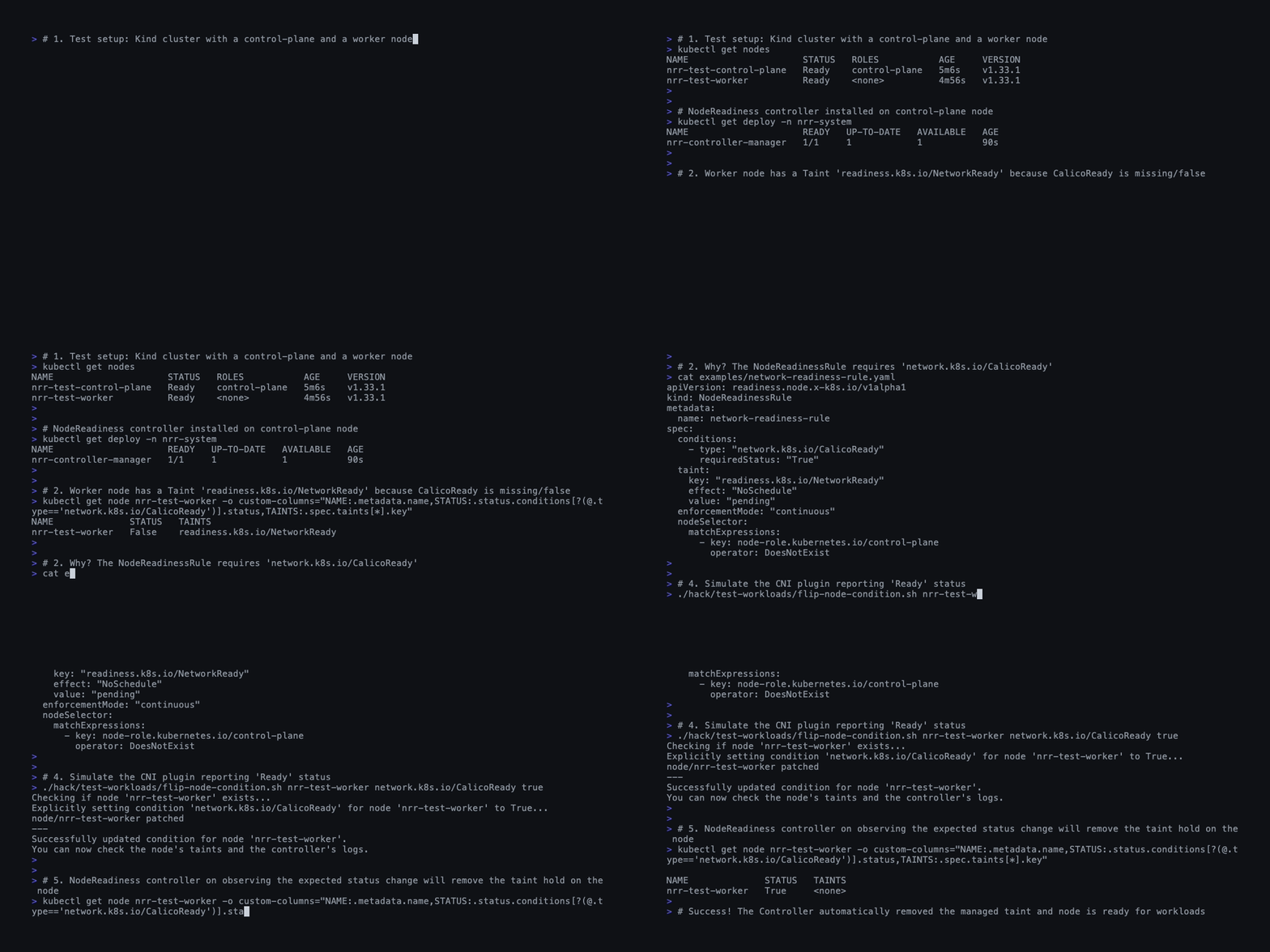
Node Readiness Controller in Kind cluster
Example Rule
apiVersion: readiness.node.x-k8s.io/v1alpha1
kind: NodeReadinessRule
metadata:
  name: network-readiness-rule
spec:
  conditions:
    - type: "example.com/CNIReady"
      requiredStatus: "True"
  taint:
    key: "readiness.k8s.io/NetworkReady"
    effect: "NoSchedule"
    value: "pending"
  enforcementMode: "bootstrap-only"
  nodeSelector:
    matchLabels:
      node-role.kubernetes.io/worker: ""
Getting Involved
If you’re interested in participating in future discussions or development related to Node Readiness Controller, you can reach the maintainers of the project at:
- Slack: #sig-node-readiness-controller (visit slack.k8s.io for a workspace invitation)
Open Issues / PRs / Discussions here:
- Issues: GitHub Issues
- Discussions: GitHub Discussions
See the Kubernetes community on the community page. You can also engage with SIG Node at #sig-node and mailing list.
Project Status
This project is currently in alpha. The API may change in future releases.
Concepts
This section explores the core concepts of the Node Readiness Controller and how to use it to manage node lifecycle.
Node Readiness Rule (NRR)
The NodeReadinessRule is the primary resource used to define readiness criteria for your nodes. It allows you to define declarative “gates” that a node must pass before it is considered ready for workloads.
A rule specifies:
- Target Nodes: Which nodes the rule applies to (using
nodeSelector). - Readiness Conditions: A list of conditions (type and status) that must be met.
- Readiness Taint: The taint to apply to the node if the conditions are not met.
When a rule is created, the controller continuously watches all matching nodes. If a node does not satisfy the required conditions, the controller ensures the configured taint is present, preventing the scheduler from assigning new pods to that node.
Readiness Domain and Taint Keys
Node Readiness Controller uses the readiness.k8s.io domain for taints and annotations that it owns. All spec.taint.key values in NodeReadinessRule must start with the readiness.k8s.io/ prefix; this is enforced by the CRD schema.
Typical taint keys look like:
readiness.k8s.io/cni.example.net/network-not-readyreadiness.k8s.io/csi.vendor.com/storage-driver-not-readyreadiness.k8s.io/<dns.subdomain>/<component-name>
The segment after readiness.k8s.io/ should describe the dependency or subsystem whose readiness is being guarded (for example, a CNI plugin, storage backend, or security agent). Treat this domain as reserved for the controller and closely related components, and avoid reusing it for unrelated taints.
Enforcement Modes
The controller supports two distinct modes of enforcement, configured via spec.enforcementMode, to handle different operational needs.
1. Continuous Enforcement (continuous)
In this mode, the controller actively maintains the readiness guarantee throughout the entire lifecycle of the node.
- Behavior:
- If conditions fail: The taint is applied immediately.
- If conditions pass: The taint is removed.
- Use Case: Critical infrastructure dependencies that must always be healthy.
- Example: A CNI plugin or a storage daemon must be running. If they crash, you want the node effectively taken offline (tainted) immediately to prevent application failures.
2. Bootstrap-Only Enforcement (bootstrap-only)
In this mode, the controller enforces readiness only during the initial node startup (bootstrap).
- Behavior:
- The taint is applied when the node first joins or the rule is created.
- The controller waits for the conditions to be met.
- Once satisfied:
- The taint is removed.
- A completion marker is added to the node’s annotations:
readiness.k8s.io/bootstrap-completed-<ruleName>=true.
- After completion: The controller ignores this rule for the node, even if the conditions fail later.
- Use Case: One-time initialization steps.
- Example: Pre-pulling heavy container images, initializing a local cache, or performing hardware provisioning that only needs to happen once per boot.
Readiness Condition Reporting
The Node Readiness Controller operates on Node Conditions. It does not perform health checks itself; rather, it reacts to the state of conditions on the Node object.
This design decouples the policy (the Controller) from the health checking (the Reporter). You have multiple options for reporting these conditions:
Option 1: Node Problem Detector (NPD)
The Node Problem Detector is a standard Kubernetes add-on commonly found in many clusters. It is designed to monitor node health and update NodeConditions or emit Events.
You can extend NPD with Custom Plugins (Monitor Scripts) to check the status of your specific components (e.g., checking if a daemon process is running or if a local endpoint is responding).
Why choose NPD?
- Existing Infrastructure: Leverages a tool that may already be running and authorized to update node status.
- Separation of Concerns: Decouples the monitoring logic from the workload itself (no need to modify your DaemonSet manifests to add sidecars).
- Centralized Config: Health checks are defined in NPD configuration rather than scattered across workload pod specs.
Option 2: Readiness Condition Reporter
To help you integrate custom checks where NPD might not be suitable, the project includes a lightweight Readiness Condition Reporter. This is designed to be run as a sidecar container within your DaemonSet.
- How it works:
- It can run as a side-car container that runs in the same Pod as your workload.
- It periodically checks a local http endpoint (e.g., healthz probe).
- It patches the Node status with a custom Condition (e.g.,
example.com/MyCustomServiceReady).
When to choose the Reporter?
- Simplicity: Good for simple “is this HTTP endpoint up?” checks without configuring external scripts.
- Direct Coupling: Useful when you want the readiness reporting lifecycle of the component to strictly match the pod’s lifecycle.
Dry Run Mode
To reduce the operational risks while deploying new readiness rules in production, the controller includes a dryRun capability to first analyze the impact before actual deployment.
When spec.dryRun: true is set on a rule:
- The controller evaluates all nodes against the criteria.
- No taints are applied or removed.
- The intended actions are reported in the
status.dryRunResultsfield of theNodeReadinessRule.
This allows you to preview exactly which nodes would be affected and identifying any potential misconfigurations (like a typo in a label selector) before they impact your cluster.
Installation
Follow this guide to install the Node Readiness Controller in your Kubernetes cluster.
Prerequisites
If you plan to use the install-full.yaml option (which includes secure metrics and the validating admission webhook), you must first have cert-manager installed in your cluster.
Deployment Options
Option 1: Official Release (Recommended)
First, to install the CRDs, apply the crds.yaml manifest:
# Replace with the desired version
VERSION=v0.1.1
kubectl apply -f https://github.com/kubernetes-sigs/node-readiness-controller/releases/download/${VERSION}/crds.yaml
kubectl wait --for condition=established --timeout=30s crd/nodereadinessrules.readiness.node.x-k8s.io
2. Install the Controller
Choose one of the two following manifests based on your requirements:
| Manifest | Contents | Prerequisites |
|---|---|---|
install.yaml | Core Controller | None |
install-full.yaml | Core Controller + Metrics (Secure) + Validation Webhook | cert-manager |
Standard Installation (Minimal): The simplest way to deploy the controller with no external dependencies.
kubectl apply -f https://github.com/kubernetes-sigs/node-readiness-controller/releases/download/${VERSION}/install.yaml
Full Installation (Production Ready): Includes secure metrics (TLS-protected) and validating webhooks for rule conflict prevention. Requires cert-manager to be installed in your cluster.
kubectl apply -f https://github.com/kubernetes-sigs/node-readiness-controller/releases/download/${VERSION}/install-full.yaml
This will deploy the controller into the nrr-system namespace on any available node in your cluster.
Controller priority
The controller is deployed with system-cluster-critical priority to prevent eviction during node resource pressure.
If it gets evicted during resource pressure, nodes can’t transition to Ready state, blocking all workload scheduling cluster-wide.
This is the priority class used by other critical cluster components (eg: core-dns).
Images
The official releases use multi-arch images (AMD64, Arm64) and are available at registry.k8s.io/node-readiness-controller/node-readiness-controller
REPO="registry.k8s.io/node-readiness-controller/node-readiness-controller"
TAG=$(skopeo list-tags docker://$REPO | jq .'Tags[-1]' | tr -d '"')
docker pull $REPO:$TAG
Option 2: Advanced Deployment (Kustomize)
If you need deeper customization, you can use Kustomize directly from the source.
# 1. Install CRDs
kubectl apply -k config/crd

# 2. Deploy Controller with default configuration
kubectl apply -k config/default
You can enable optional components (Metrics, TLS, Webhook) by creating a kustomization.yaml that includes the relevant components from the config/ directory. For reference on how these components can be combined, see the deploy-with-metrics, deploy-with-tls, deploy-with-webhook, and deploy-full targets in the projects Makefile.
Option 3: Deploy as a Static Pod (Control Plane)
Running the controller as a Static Pod on control-plane nodes is useful for self-managed clusters (e.g., kubeadm) where you want the controller to be available alongside core components like the API server.
Refer to the examples/static-pod/node-readiness-controller.yaml for a detailed
example on deploying the controller as a static pod in a kind cluster.
Deployment Steps
-
Prepare the Manifest: Refer the example manifest in
examples/static-pod/node-readiness-controller.yaml. This manifest handles kubeconfig with ainitContainerand necessary flags for leader election. -
Deploy to Nodes: Use Ansible / Terraform to copy the manifest to the
/etc/kubernetes/manifests/directory on each control-plane node. The Kubelet will automatically detect and start the pod. -
Install CRDs:
kubectl apply -k config/crdThis is typically handled via a bootstrap script or post-install job in a
kubeadmsetup.
Verification
After installation, verify that the controller is running successfully.
Note: Replace
${NAMESPACE}with the namespace where the controller is deployed (typicallynrr-systemfor standard deployments, orkube-systemfor static pods).
-
Check Pod Status:
kubectl get pods -n ${NAMESPACE} -l component=node-readiness-controllerYou should see the controller pods in
Runningstatus. -
Check Logs:
kubectl logs -n ${NAMESPACE} -l component=node-readiness-controllerLook for “Starting EventSource” or “Starting Controller” messages indicating the manager is active.
-
Verify CRDs:
kubectl get crd nodereadinessrules.readiness.node.x-k8s.io -
Verify High Availability: In an HA cluster, verify that one instance has acquired the leader lease:
# The lease namespace should match the controller's namespace (configured via --leader-election-namespace)
kubectl get lease -n ${NAMESPACE} ba65f13e.readiness.node.x-k8s.io
Uninstallation
IMPORTANT: Follow this order to avoid “stuck” resources.
The controller uses a finalizer (readiness.node.x-k8s.io/cleanup-taints) on NodeReadinessRule resources to ensure taints are safely removed from nodes before a rule is deleted.
You must delete all rule objects before deleting the controller.
-
Delete all Rules:
kubectl delete nodereadinessrules --allWait for this command to complete. This ensures the running controller removes its taints from your nodes.
-
Uninstall Controller:
# If installed via release manifest kubectl delete -f https://github.com/kubernetes-sigs/node-readiness-controller/releases/download/${VERSION}/install.yaml # Or if using the full manifest kubectl delete -f https://github.com/kubernetes-sigs/node-readiness-controller/releases/download/${VERSION}/install-full.yaml # OR if using Kustomize kubectl delete -k config/default # OR if using Static Pods # Remove the manifest from /etc/kubernetes/manifests/ on all control-plane nodes -
Uninstall CRDs (Optional):
kubectl delete -k config/crd
Recovering from Stuck Resources
If you accidentally deleted the controller before the rules, the NodeReadinessRule objects will get stuck in a Terminating state because the controller is needed to cleanup the taints and finalizers.
To force-delete them (this will require you to manually clean up the managed taints if any on your nodes):
# Patch the finalizer to remove it
kubectl patch nodereadinessrule <rule-name> -p '{"metadata":{"finalizers":[]}}' --type=merge
Troubleshooting Deployment
RBAC Permissions If the controller logs show “Forbidden” errors, verify the ClusterRole bindings:
kubectl describe clusterrole nrr-manager-role
It requires nodes (update/patch) and nodereadinessrules (all) access.
Debug Logging To enable verbose logging for deeper investigation:
kubectl patch deployment -n nrr-system nrr-controller-manager \
  -p '{"spec":{"template":{"spec":{"containers":[{"name":"manager","args":["--zap-log-level=debug"]}]}}}}'
Getting Started
This guide covers how to use the Node Readiness Controller to define and enforce node readiness checks using NodeReadinessRule resources.
Prerequisites: Node Readiness Controller must be installed. See Installation.
Creating a Readiness Rule
The core resource is the NodeReadinessRule CRD. It defines a set of conditions
that a node must meet to be considered “workload ready”. If the conditions are
not met, the controller applies a specific taint to the node.
Basic Example: Storage Readiness
Here is a rule that ensures a storage plugin is registered before allowing workloads that need it.
apiVersion: readiness.node.x-k8s.io/v1alpha1
kind: NodeReadinessRule
metadata:
  name: storage-readiness-rule
spec:
  # The label selector determines which nodes this rule applies to
  nodeSelector:
    matchLabels:
      storage-backend: "nfs"

  # The conditions that must be True for the node to be considered ready
  conditions:
    - type: "csi.example.com/NodePluginRegistered"
      requiredStatus: "True"
    - type: "csi.example.com/BackendReachable"
      requiredStatus: "True"

  # The taint to apply if conditions are NOT met
  taint:
    key: "readiness.k8s.io/vendor.com/nfs-unhealthy"
    effect: "NoSchedule"

  # When to enforce: 'bootstrap-only' (initial setup) or 'continuous' (ongoing health)
  enforcementMode: "continuous"
Configuring the Rule
1. Select Target Nodes
Use the nodeSelector to target specific nodes (eg., GPU nodes).
Note: These labels could be configured at node registration (e.g., via Kubelet
--node-labels). Relying on labels added asynchronously by addons (like Node Feature Discovery) can create a race condition where the node remains schedulable until the labels appear.
2. Define Readiness Conditions
The conditions list defines the criteria. The controller watches the Node’s status for these conditions.
type: The exact string matching the NodeCondition type.requiredStatus: The status required (True,False, orUnknown).
3. Choose an Enforcement Mode
The enforcementMode determines how the controller manages the taint lifecycle.
bootstrap-only: Use this for one-time initialization tasks (e.g., installing a kernel module or driver). Once the conditions are met once, the taint is removed and never reapplied.continuous: Use this for ongoing health checks (e.g., network connectivity). If the condition fails at any time, the taint is reapplied.
For more details on these modes, see Concepts.
4. Configure the Taint
Define the taint that will block scheduling.
- Key: Must start with
readiness.k8s.io/prefix. - Effect:
NoSchedule: Prevents new pods from scheduling (Recommended).PreferNoSchedule: Tries to avoid scheduling.NoExecute: Evicts running pods if they don’t tolerate the taint.
Note: To eliminate startup race conditions, register nodes with this taint (e.g., via Kubelet
--register-with-taints). The controller will remove it once conditions are met.
Caution: When using
NoExecutewithcontinuousmode: if a condition fails momentarily, all workloads on the node (without tolerations) will be immediately evicted, which can cause service disruption.
The admission webhook warns when using NoExecute taint:
$ kubectl apply -f rule.yaml
Warning: NOTE: NoExecute will evict existing pods without tolerations. Ensure critical system pods have appropriate tolerations
nodereadinessrule.readiness.node.x-k8s.io/my-rule created
Rule Validations
Avoiding Taint Key Conflicts
The admission webhook prevents multiple rules from using the same taint.key and taint.effect on overlapping node selectors.
Example conflict:
# Rule 1
spec:
  conditions:
    - type: "device.gpu-vendor.net/DevicePluginRegistered"
      requiredStatus: "True"
  nodeSelector:
    matchLabels:
      feature.node.kubernetes.io/pci-10de.present: "true"
  taint:
    key: "readiness.k8s.io/vendor.com/gpu-not-ready"
    effect: "NoSchedule"

# Rule 2 - This will be REJECTED
spec:
  conditions:
    - type: "cniplugin.example.net/rdma/NetworkReady"
    requiredStatus: "True"
  nodeSelector:
    matchLabels:
      feature.node.kubernetes.io/pci-10de.present: "true"
  taint:
    key: "readiness.k8s.io/vendor.com/gpu-not-ready"  # Same (taint-key + effect) but different conditions = conflict
    effect: "NoSchedule"
Taint Key Naming
Taint keys must have the readiness.k8s.io/ prefix to clearly identify
readiness-related taints and avoid conflicts with other controllers.
Use unique, descriptive taint keys for different readiness checks. Follow Kubernetes naming conventions.
Valid:
taint:
  key: "readiness.k8s.io/vendor.com/network-not-ready"
  key: "readiness.k8s.io/vendor.com/gpu-not-ready"
Invalid:
taint:
  key: "network-ready"              # Missing prefix
  key: "node.kubernetes.io/ready"   # Wrong prefix
Testing with Dry Run
You can preview the impact of a rule without actually tainting nodes using dryRun.
spec:
  dryRun: true  # Enable dry run mode
  conditions:
    - type: "csi.example.com/NodePluginRegistered"
      requiredStatus: "True"
Check the status of the rule to follow the results:
kubectl get nodereadinessrule my-rule -o yaml
Look for dryRunResults in the output to see which nodes would be tainted.
Reporting Node Conditions
The Node Readiness Controller only ‘reacts’ to observed conditions on the Node object. These conditions can be set by various tools:
- Node Problem Detector (NPD): You can configure NPD with custom plugins to monitor system state and report conditions.
- Custom Health-Checkers or Sidecars: You can run a daemonset or a small sidecar (eg., Readiness Condition Reporter) that checks your application or driver and updates the Node status.
- External Controllers: Any tool that can patch Node status can trigger these rules.
For a full example of setting up a custom condition for a security agent, see the Security Agent Readiness Example.
CNI Readiness
In many Kubernetes clusters, the CNI plugin runs as a DaemonSet. When a new node joins the cluster, there is a race condition:
- The Node object is created and marked
Readyby the Kubelet. - The Scheduler sees the node as
Readyand schedules application pods. - However, the CNI DaemonSet might still be initializing networking on that node.
This guide demonstrates how to use the Node Readiness Controller to prevent pods from being scheduled on a node until the Container Network Interface (CNI) plugin (e.g., Calico) is fully initialized and ready.
The high-level steps are:
- Node is bootstrapped with a startup taint
readiness.k8s.io/NetworkReady=pending:NoScheduleimmediately upon joining. - A reporter DaemonSet is deployed to monitor the CNI’s health and report it to the API server as node-condition (
projectcalico.org/CalicoReady). - Node Readiness Controller will untaint the node only when the CNI reports it is ready.
Step-by-Step Guide
This example uses Calico, but the pattern applies to any CNI.
Note: You can find all the manifests used in this guide in the
examples/cni-readinessdirectory.
1. Deploy the Readiness Condition Reporter
We need to bridge Calico’s internal health status to a Kubernetes Node Condition. We will deploy a reporter DaemonSet that runs on every node.
This reporter checks Calico’s local health endpoint (http://localhost:9099/readiness) and updates a node condition projectcalico.org/CalicoReady.
Using a separate DaemonSet instead of a sidecar ensures that readiness reporting works even if the CNI pod is crashlooping or failing to start containers.
Deploy the Reporter DaemonSet:
# cni-reporter-ds.yaml
apiVersion: apps/v1
kind: DaemonSet
metadata:
  name: cni-reporter
  namespace: kube-system
spec:
  # ...
  template:
    spec:
      hostNetwork: true
      serviceAccountName: cni-reporter
      tolerations:
      - operator: Exists
      containers:
      - name: cni-status-patcher
        image: registry.k8s.io/node-readiness-controller/node-readiness-reporter:v0.1.1
        env:
          - name: CHECK_ENDPOINT
            value: "http://localhost:9099/readiness"
          - name: CONDITION_TYPE
            value: "projectcalico.org/CalicoReady"
2. Grant Permissions (RBAC)
The reporter needs permission to update the Node object’s status.
# calico-rbac-node-status-patch-role.yaml
apiVersion: rbac.authorization.k8s.io/v1
kind: ClusterRole
metadata:
  name: node-status-patch-role
rules:
- apiGroups: [""]
  resources: ["nodes/status"]
  verbs: ["patch", "update"]
---
apiVersion: rbac.authorization.k8s.io/v1
kind: ClusterRoleBinding
metadata:
  name: calico-node-status-patch-binding
roleRef:
  apiGroup: rbac.authorization.k8s.io
  kind: ClusterRole
  name: node-status-patch-role
subjects:
# Bind to CNI Reporter's ServiceAccount
- kind: ServiceAccount
  name: cni-reporter
  namespace: kube-system
3. Create the Node Readiness Rule
Now define the rule that enforces the requirement. This tells the controller: “Keep the readiness.k8s.io/NetworkReady taint on the node until projectcalico.org/CalicoReady is True.”
# network-readiness-rule.yaml
apiVersion: readiness.node.x-k8s.io/v1alpha1
kind: NodeReadinessRule
metadata:
  name: network-readiness-rule
spec:
  # The condition(s) to monitor
  conditions:
    - type: "projectcalico.org/CalicoReady"
      requiredStatus: "True"

  # The taint to manage
  taint:
    key: "readiness.k8s.io/NetworkReady"
    effect: "NoSchedule"
    value: "pending"

  # "bootstrap-only" means: once the CNI is ready once, we stop enforcing.
  enforcementMode: "bootstrap-only"

  # Update to target only the nodes that need to be protected by this guardrail
  nodeSelector:
    matchLabels:
      node-role.kubernetes.io/worker: ""
Test scripts
-
Create the Readiness Rule:
cd examples/cni-readiness kubectl apply -f network-readiness-rule.yaml -
Install Calico CNI and Apply the RBAC:
chmod +x apply-calico.sh
sh apply-calico.sh
Verification
To test this, add a new node to the cluster.
-
Check the Node Taints: Immediately upon joining, the node should have the taint:
readiness.k8s.io/NetworkReady=pending:NoSchedule. -
Check Node Conditions: Watch the node conditions. You will initially see
projectcalico.org/CalicoReadyasFalseor missing. Once Calico starts, the reporter will update it toTrue. -
Check Taint Removal: As soon as the condition becomes
True, the Node Readiness Controller will remove the taint, and workloads will be scheduled.
Security Agent Readiness Guardrail
This guide demonstrates how to use the Node Readiness Controller to prevent workloads from being scheduled on a node until a security agent (for example, Falco) is fully initialized and actively monitoring the node.
The Problem
In many Kubernetes clusters, security agents are deployed as DaemonSets. When a new node joins the cluster, there is a race condition:
- A new node joins the cluster and is marked
Readyby the kubelet. - The scheduler sees the node as
Readyand considers the node eligible for workloads. - However, the security agent on that node may still be starting or initializing.
Result: Application workloads may start running before node is security compliant, creating a blind spot where runtime threats, policy violations, or anomalous behavior may go undetected.
The Solution
We can use the Node Readiness Controller to enforce a security readiness guardrail:
- Taint the node with a startup taint
readiness.k8s.io/security-agent-ready=pending:NoScheduleas soon as it joins the cluster. - Monitor the security agent’s readiness using a sidecar and expose it as a Node Condition.
- Untaint the node only after the security agent reports that it is ready.
Step-by-Step Guide (Falco Example)
This example uses Falco as a representative security agent, but the same pattern applies to any node-level security or monitoring agent.
Note: All manifests referenced in this guide are available in the
examples/security-agent-readinessdirectory.
Prerequisites
1. Node Readiness Controller:
Before starting, ensure the Node Readiness Controller is deployed. See the Installation Guide for details.
2. Kubernetes Cluster with Worker Nodes:
This example requires at least one worker node with the startup taint. For kind clusters, use the provided configuration:
kind create cluster --config examples/security-agent-readiness/kind-cluster-config.yaml
This creates a cluster with:
- 1 control-plane node
- 1 worker node pre-tainted with
readiness.k8s.io/security-agent-ready=pending:NoSchedule
See examples/security-agent-readiness/kind-cluster-config.yaml for details.
1. Deploy the Readiness Condition Reporter
To bridge the security agent’s internal health signal to Kubernetes, we need to update a Node Condition. You have two options:
Option A: Using Node Readiness Reporter Sidecar
The reporter is deployed as a sidecar container in the Falco DaemonSet. This sidecar periodically checks Falco’s local health endpoint (http://localhost:8765/healthz) and updates a Node Condition falco.org/FalcoReady.
Patch your Falco DaemonSet:
# security-agent-reporter-sidecar.yaml
- name: security-status-patcher
  image: registry.k8s.io/node-readiness-controller/node-readiness-reporter:v0.1.1
  imagePullPolicy: IfNotPresent
  env:
    - name: NODE_NAME
      valueFrom:
        fieldRef:
          fieldPath: spec.nodeName
    - name: CHECK_ENDPOINT
      value: "http://localhost:8765/healthz" # Update the right security agent endpoint
    - name: CONDITION_TYPE
      value: "falco.org/FalcoReady"   # Update the right condition
    - name: CHECK_INTERVAL
      value: "5s"
  resources:
    limits:
      cpu: "10m"
      memory: "32Mi"
    requests:
      cpu: "10m"
      memory: "32Mi"
Note: The sidecar’s lifecycle is tied to the Falco pod. If Falco crashes, the sidecar stops reporting. For more robust monitoring, see Option B below.
Option B: Using Node Problem Detector (More Robust)
If you already have Node Problem Detector (NPD) deployed or want robust monitoring that continues even if Falco crashes, use NPD with a custom plugin.
Deploy NPD with Falco monitoring plugin:
# npd-falco-config.yaml
apiVersion: v1
kind: ConfigMap
metadata:
  name: npd-falco-config
  namespace: falco
data:
  # NPD uses problem-oriented conditions (like MemoryPressure, DiskPressure).
  # falco.org/FalcoNotReady=False means Falco is healthy, falco.org/FalcoNotReady=True means there's an issue.
  falco-plugin.json: |
    {
      "plugin": "custom",
      "pluginConfig": {
        "invoke_interval": "10s",
        "timeout": "5s",
        "max_output_length": 80,
        "concurrency": 1
      },
      "source": "falco-monitor",
      "conditions": [
        {
          "type": "falco.org/FalcoNotReady",
          "reason": "FalcoHealthy",
          "message": "Falco security monitoring is functional"
        }
      ],
      "rules": [
        {
          "type": "permanent",
          "condition": "falco.org/FalcoNotReady",
          "reason": "FalcoNotDeployed",
          "path": "/config/plugin/check-falco.sh"
        }
      ]
    }

  check-falco.sh: |
    #!/bin/bash
    # Check if Falco is deployed and healthy
    # Exit 0 when healthy (FalcoNotReady=False, i.e., Falco IS ready)
    # Exit 1 when NOT healthy/deployed (FalcoNotReady=True, i.e., Falco is NOT ready)
    timeout 2 bash -c '</dev/tcp/127.0.0.1/8765' 2>/dev/null
    if [ $? -eq 0 ]; then
      exit 0  # Falco is healthy
    else
      echo "Falco is not deployed or not responding on port 8765"
      exit 1  # Falco has a problem
    fi
Then deploy NPD DaemonSet and RBAC. See complete NPD manifests in examples/security-agent-readiness/npd-variant/.
2. Create the Node Readiness Rule
Next, define a NodeReadinessRule that enforces the security readiness requirement.
For Option A (Sidecar Reporter):
# nrr-variant/security-agent-readiness-rule.yaml
apiVersion: readiness.node.x-k8s.io/v1alpha1
kind: NodeReadinessRule
metadata:
  name: security-agent-readiness-rule
spec:
  # Conditions that must be satisfied before the taint is removed
  conditions:
    - type: "falco.org/FalcoReady"
      requiredStatus: "True"

  # Taint managed by this rule
  taint:
    key: "readiness.k8s.io/security-agent-ready"
    effect: "NoSchedule"
    value: "pending"

  # "bootstrap-only" means: once the security agent is ready, we stop enforcing.
  # Use "continuous" mode if you want to taint the node if security agent crashes later.
  enforcementMode: "bootstrap-only"

  # Update to target only the nodes that need to be protected by this guardrail
  nodeSelector:
    matchLabels:
      node-role.kubernetes.io/worker: ""
For Option B (Node Problem Detector):
# npd-variant/security-agent-readiness-rule-npd.yaml
apiVersion: readiness.node.x-k8s.io/v1alpha1
kind: NodeReadinessRule
metadata:
  name: security-agent-readiness-rule-npd
spec:
  # Conditions that must be satisfied before the taint is removed
  conditions:
    - type: "falco.org/FalcoNotReady"
      requiredStatus: "False"  # Remove taint when Falco is NOT NotReady (i.e., ready)

  # Taint managed by this rule
  taint:
    key: "readiness.k8s.io/security-agent-ready"
    effect: "NoSchedule"
    value: "pending"

  # "bootstrap-only" means: once the security agent is ready, we stop enforcing.
  # Use "continuous" mode if you want to re-taint the node if Falco crashes later.
  enforcementMode: "continuous"

  # Update to target only the nodes that need to be protected by this guardrail
  nodeSelector:
    matchLabels:
      node-role.kubernetes.io/worker: ""
How to Apply
For Option A (Sidecar Reporter):
# Install Falco with sidecar reporter
USE_NRR=true examples/security-agent-readiness/setup-falco.sh

# Apply the NodeReadinessRule
kubectl apply -f examples/security-agent-readiness/nrr-variant/security-agent-readiness-rule.yaml

# Add toleration to Falco so it can start on tainted nodes
examples/security-agent-readiness/add-falco-toleration.sh
For Option B (Node Problem Detector):
# Install Falco with NPD monitoring
USE_NPD=true examples/security-agent-readiness/setup-falco.sh

# Apply the NodeReadinessRule for NPD
kubectl apply -f examples/security-agent-readiness/npd-variant/security-agent-readiness-rule-npd.yaml

# Add toleration to Falco so it can start on tainted nodes
examples/security-agent-readiness/add-falco-toleration.sh
Verification
To verify that the guardrail is working, you need a tainted node. You have two options:
Option 1: Manually taint an existing node:
kubectl taint nodes <node-name> readiness.k8s.io/security-agent-ready=pending:NoSchedule
Option 2: Configure nodes to register with taints at startup:
For kind clusters, use kubeadm config patches. See kind documentation on kubeadm config patches for details.
Once the node is tainted:
-
Check the Node Taints: Verify the taint is applied:
kubectl get nodes -o custom-columns=NAME:.metadata.name,TAINTS:.spec.taintsShould show:
readiness.k8s.io/security-agent-ready=pending:NoSchedule. -
Check Node Conditions:
For Option A (Sidecar):
kubectl get node <node-name> -o jsonpath='{.status.conditions[?(@.type=="falco.org/FalcoReady")]}' | jq .You will initially see
falco.org/FalcoReadyasFalse. Once Falco initializes, it becomesTrue.For Option B (NPD):
kubectl get node <node-name> -o jsonpath='{.status.conditions[?(@.type=="falco.org/FalcoNotReady")]}' | jq .You will initially see
falco.org/FalcoNotReady=True(not ready). Once Falco is healthy, it becomesfalco.org/FalcoNotReady=False(ready). -
Check Taint Removal: As soon as the condition reaches the required status, the Node Readiness Controller removes the taint, allowing workloads to be scheduled on the node.
Secure Status Reporting
By default, a readiness reporter’s ServiceAccount is granted broad permissions to update the status of any Node in the cluster. If a node is compromised, an attacker can manipulate the readiness status of every other node.
Constrained Impersonation (KEP-5284) solves this by allowing the reporter to impersonate only the Node it runs on. The API server enforces this at the authorization layer, so that no other node’s status can be touched.
This guide walks through a CNI readiness example that uses constrained impersonation instead of broad RBAC. It is a hardened variant of the CNI Readiness example.
Prerequisites: Kubernetes v1.35+ with the
ConstrainedImpersonationfeature gate enabled, or v1.36+ where it is Beta and enabled by default.
Note: You can find all the manifests used in this guide in the
examples/constrained-impersonationdirectory.
Step-by-Step Guide
1. Create a Kind Cluster
Create a cluster with the ConstrainedImpersonation feature gate enabled and worker nodes that join with a startup taint:
kind create cluster \
  --config config/testing/kind/kind-constrained-impersonation-config.yaml \
  --image kindest/node:v1.35.0
2. Install the CRDs and Controller
make install
make deploy
3. Deploy the Example
cd examples/constrained-impersonation
kubectl apply -f .
4. RBAC Explained
The RBAC consists of two ClusterRoles:
Impersonation role — allows the reporter to impersonate its own Node:
apiVersion: rbac.authorization.k8s.io/v1
kind: ClusterRole
metadata:
  name: node-readiness-impersonator
rules:
- apiGroups: ["authentication.k8s.io"]
  resources: ["nodes"]
  verbs: ["impersonate:associated-node"]
Constrained action role — restricts what the impersonated identity can do:
apiVersion: rbac.authorization.k8s.io/v1
kind: ClusterRole
metadata:
  name: node-status-patcher-constrained
rules:
- apiGroups: [""]
  resources: ["nodes"]
  verbs: ["impersonate-on:associated-node:get"]
- apiGroups: [""]
  resources: ["nodes/status"]
  verbs: ["impersonate-on:associated-node:update"]
5. Verification
Check that the reporter is running:
kubectl -n kube-system get pods -l app=cni-reporter
Check node conditions:
kubectl get nodes -o custom-columns='NAME:.metadata.name,CALICO_READY:.status.conditions[?(@.type=="projectcalico.org/CalicoReady")].status'
6. Security Verification
Verify the ServiceAccount has no direct permissions:
kubectl auth can-i get nodes --as=system:serviceaccount:kube-system:cni-reporter
# no
kubectl auth can-i update nodes/status --as=system:serviceaccount:kube-system:cni-reporter
# no
The SA cannot read or update any node directly; all access goes through constrained impersonation.
Verify the reporter can still update its own node (via impersonation):
kubectl get nodes -o custom-columns='NAME:.metadata.name,CALICO_READY:.status.conditions[?(@.type=="projectcalico.org/CalicoReady")].status'
The CalicoReady condition should appear on every node.
This proves the reporter is successfully impersonating its local node identity and writing status.
Comparison with Broad RBAC
For a deeper discussion, see Security.
Releases
This page details the official releases of the Node Readiness Controller.
v0.3.0
Date: 2026-03-18
This release focuses on security hardening, observability, and flexibility. Key updates include immutability for NodeReadinessRule spec fields, constrained impersonation for secure node status updates, and support for static pod installation flows. It also introduces node events for taint operations and several maintenance updates to address vulnerabilities.
Release Notes
Features & Enhancements
- Make
NodeReadinessRulespec fields immutable (#164) - Add graceful shutdown and propagate context in readiness-condition-reporter (#174)
- Propagate context and use merge patch in bootstrap completion tracking (#173)
- Improve security posture by pruning unnecessary RBAC (#172)
- Add CEL validation for taint key format against Kubernetes qualified name rule (#155)
- Support static pod installation flow for control-plane nodes (#162)
- Add Podman support (#157)
- Constrained impersonation for secure node status updates (#143)
- Add node events for taint operations (TaintAdded, TaintRemoved, TaintAdopted) (#158)
- Restrict
NodeReadinessRuleSpec.Taintto “readiness.k8s.io/” prefix (#112) - Add TLS and webhook installation support to Makefile (#146)
Code Cleanup & Maintenance
- Update
manager.yamlto modify nodeSelector and tolerations (#129) - Bump golang version to address vulnerabilities (#169)
- Fix linter and bump golangci-lint version (#168)
- CVE fix: update otel sdk to 1.40.0 (#170)
- Add release automation workflow (#144)
Documentation & Examples
- Add NPD (node problem detector) variant for security-agent-readiness example (#154)
- Add link checker to fix broken links in markdown (#140)
- Update release notes for checking image promotion (#149)
- Add controller metrics reference (#153)
- Add installation steps for deploy-full target (#147)
- Update
Test_READMEfile with small format change (#145) - Fix NodeReadinessGates KEP number - KEP-5233 (#156)
Images
The following container images are published as part of this release.
// Node readiness controller
registry.k8s.io/node-readiness-controller/node-readiness-controller:v0.3.0

// Report component readiness condition from the node
registry.k8s.io/node-readiness-controller/node-readiness-reporter:v0.3.0
Contributors
- ajaysundar.k
- Ali Abbasi Alaei
- Anish Ramasekar
- Avinesh Tripathi
- Karthik Bhat
- Mohammad Faraz
- Priyanka Saggu
- Rohit Chaudhari
- Sathvik S
- Swarom
v0.2.0
Date: 2026-02-28
This release brings several new features, including a validating admission webhook that validates NodeReadinessRule configurations, prevents conflicting rules with overlapping node selectors, and warns against risky NoExecute enforcement. It also introduces metrics manifests natively integrated with Kustomize, which includes support for secure metrics via TLS. Finally, this release includes major documentation improvements.
Release Notes
Features & Enhancements
- Add webhook as kustomize component (#122)
- Enable metrics manifests (#79)
- Use
status.patchapi for node updates (#104) - Mark controller as
system-cluster-criticalto prevent eviction (#108) - Enhance Dockerfiles and bump Go module version (#113)
- Add
build-installermake target to create CRD and install manifests (#95, #93) - Add a pull request template (#110)
Bug Fixes
- Fix dev-container: disable moby in newer version of debian (#127)
- Add missing boilerplate headers in
metrics.go(#119) - Update path to logo in README (#115)
Code Cleanup & Maintenance
- Remove unused
globalDryRunfeature (#123, #130) - Bump versions for devcontainer and golangci-kal (#132)
Documentation & Examples
- Document
NoExecutetaint risks and add admission warning (#120) - Updates on getting-started guide and installation docs (#135, #92)
- Add example for security agent readiness (#101)
- Managing CNI-readiness with node-readiness-controller and switch reporter to daemonset (#99, #116)
- Update cni-patcher to use
registry.k8s.ioimage (#96) - Add video demo (#114) and update heptagon logo (#109)
- Remove stale
docs/spec.md(#126)
Images
The following container images are published as part of this release.
// Node readiness controller
registry.k8s.io/node-readiness-controller/node-readiness-controller:v0.2.0

// Report component readiness condition from the node
registry.k8s.io/node-readiness-controller/node-readiness-reporter:v0.2.0
Installation
Prerequisites: If you plan to install with all optional features enabled (install-full.yaml), you must have cert-manager installed in your cluster.
To install the CRDs, apply the crds.yaml manifest for this version:
kubectl apply -f https://github.com/kubernetes-sigs/node-readiness-controller/releases/download/v0.2.0/crds.yaml
To install the controller, choose one of the following manifests based on your requirements:
| Manifest | Contents | Prerequisites |
|---|---|---|
install.yaml | Core Controller | None |
install-full.yaml | Core Controller + Metrics (Secure) + Validation Webhook | cert-manager |
Standard Installation (Minimal): The simplest way to deploy the controller with no external dependencies.
kubectl apply -f https://github.com/kubernetes-sigs/node-readiness-controller/releases/download/v0.2.0/install.yaml
Full Installation (Production Ready): Includes secure metrics (TLS-protected) and validating webhooks for rule conflict prevention. Requires cert-manager to be installed in your cluster.
kubectl apply -f https://github.com/kubernetes-sigs/node-readiness-controller/releases/download/v0.2.0/install-full.yaml
This will deploy the controller into any available node in the nrr-system namespace in your cluster. Check here for more detailed installation instructions.
Contributors
- ajaysundark
- arnab-logs
- AvineshTripathi
- GGh41th
- Hii-Himanshu
- ketanjani21
- knechtionscoding
- OneUpWallStreet
- pehlicd
- Priyankasaggu11929
- sats-23
v0.1.1
Date: 2026-01-19
This patch release includes important regression bug fixes and documentation updates made since v0.1.0.
Release Notes
Bug or Regression
- Fix race condition where deleting a rule could leave taints stuck on nodes (#84)
- Ensure new node evaluation results are persisted to rule status (#87]
Documentation
- Add/update Concepts documentation (enforcement modes, dry-run, condition reporting) (#74)
- Add v0.1.0 release notes to docs (#76)
Images
The following container images are published as part of this release.
// Node readiness controller
registry.k8s.io/node-readiness-controller/node-readiness-controller:v0.1.1

// Report component readiness condition from the node
registry.k8s.io/node-readiness-controller/node-readiness-reporter:v0.1.1
Installation
To install the CRDs, apply the crds.yaml manifest for this version:
kubectl apply -f https://github.com/kubernetes-sigs/node-readiness-controller/releases/download/v0.1.1/crds.yaml
To install the controller, apply the install.yaml manifest for this version:
kubectl apply -f https://github.com/kubernetes-sigs/node-readiness-controller/releases/download/v0.1.1/install.yaml
This will deploy the controller into any available node in the nrr-system namespace in your cluster. Check here for more installation instructions.
Contributors
- ajaysundark
v0.1.0
Date: 2026-01-14
This is the first official release of the Node Readiness Controller.
Release Notes
- Initial implementation of the Node Readiness Controller.
- Support for
NodeReadinessRuleAPI (readiness.node.x-k8s.io/v1alpha1). - Defines custom readiness rules for k8s nodes based on node conditions.
- Manages node taints to prevent scheduling until readiness rules are met.
- Includes modes for bootstrap-only and continuous readiness enforcement.
- Readiness condition reporter for reporting component health.
Images
The following container images are published as part of this release.
// Node readiness controller
registry.k8s.io/node-readiness-controller/node-readiness-controller:v0.1.0

// Report component readiness condition from the node
registry.k8s.io/node-readiness-controller/node-readiness-reporter:v0.1.0
Installation
To install the CRDs, apply the crds.yaml manifest for this version:
kubectl apply -f https://github.com/kubernetes-sigs/node-readiness-controller/releases/download/v0.1.0/crds.yaml
To install the controller, apply the install.yaml manifest for this version:
kubectl apply -f https://github.com/kubernetes-sigs/node-readiness-controller/releases/download/v0.1.0/install.yaml
This will deploy the controller into any available node in the nrr-system
namespace in your cluster. Check
here
for more installation instructions.
Contributors
- ajaysundark
- Karthik-K-N
- Priyankasaggu11929
- sreeram-venkitesh
- Hii-Himanshu
- Serafeim-Katsaros
- arnab-logs
- Yuan-prog
- AvineshTripathi
Monitoring
Node Readiness Controller exposes Prometheus-compatible metrics. This page describes the Prometheus metrics exposed by Node Readiness Controller for monitoring rule evaluation, taint operations, failures, and bootstrap progress.
Metrics Endpoint
The controller serves metrics on /metrics only when metrics are explicitly enabled. Depending on the installation, the endpoint is served either over HTTP or over HTTPS. See Installation for deployment details.
Supported Metrics
node_readiness_rules_total
Number of NodeReadinessRule objects tracked by the controller.
| Property | Value |
|---|---|
| Type | gauge |
| Labels | none |
| Recorded when | The controller refreshes or removes a tracked rule |
node_readiness_taint_operations_total
Total number of taint operations performed by the controller.
| Property | Value |
|---|---|
| Type | counter |
| Labels | rule, operation |
| Recorded when | The controller successfully adds or removes a taint |
Labels
| Label | Description | Values |
|---|---|---|
rule | NodeReadinessRule name | Any rule name |
operation | Taint operation performed by the controller | add, remove |
node_readiness_evaluation_duration_seconds
Duration of rule evaluations.
| Property | Value |
|---|---|
| Type | histogram |
| Labels | none |
| Buckets | Prometheus default histogram buckets |
| Recorded when | The controller evaluates a rule against a node |
node_readiness_failures_total
Total number of failure events recorded by the controller.
| Property | Value |
|---|---|
| Type | counter |
| Labels | rule, reason |
| Recorded when | The controller records an evaluation failure or taint add/remove failure |
Labels
| Label | Description | Values |
|---|---|---|
rule | NodeReadinessRule name | Any rule name |
reason | Failure label recorded by the controller | EvaluationError, AddTaintError, RemoveTaintError |
node_readiness_bootstrap_completed_total
Total number of nodes that have completed bootstrap.
| Property | Value |
|---|---|
| Type | counter |
| Labels | rule |
| Recorded when | The controller marks bootstrap as completed for a node under a bootstrap-only rule |
Labels
| Label | Description | Values |
|---|---|---|
rule | NodeReadinessRule name | Any rule name |
Security
The Node Readiness Controller relies on external reporters, lightweight components running on each node, to publish readiness information as Node conditions. Because these reporters must patch Node status objects, the RBAC they require needs careful attention.
The Threat Model
Reporters typically run as DaemonSet pods or sidecars on the nodes they monitor.
They use the Kubernetes API to update nodes/status with condition data that the controller consumes.
With broad RBAC (the default in Kubernetes < v1.35), a reporter’s ServiceAccount is granted patch and update on all nodes/status resources cluster-wide. This means that if a single node is compromised, an attacker can:
- Mark other nodes as ready or not-ready, influencing scheduling decisions across the cluster.
- Inject false conditions to bypass readiness gates on nodes they do not control.
This violates the principle of least privilege: a reporter should only be able to modify the status of the node it runs on.
Constrained Impersonation (KEP-5284)
Constrained Impersonation (KEP-5284) introduces authorization rules that restrict a ServiceAccount to impersonating only the Node identity associated with the pod’s bound service account token, and to performing only specific actions during that impersonation.
How It Works
Two ClusterRoles are used together:
-
Impersonation role — grants the reporter the ability to impersonate the identity of its own Node and nothing else.
apiVersion: rbac.authorization.k8s.io/v1
kind: ClusterRole
metadata:
  name: node-readiness-impersonator
rules:
- apiGroups: ["authentication.k8s.io"]
  resources: ["nodes"]
  verbs: ["impersonate:associated-node"]
The
impersonate:associated-nodeverb tells the API server to validate that the pod’s bound service account token references the same node (via theauthentication.kubernetes.io/node-nameextra key). A reporter onnode-Acannot impersonatenode-B. -
Constrained action role — restricts what the impersonated identity is allowed to do.
apiVersion: rbac.authorization.k8s.io/v1
kind: ClusterRole
metadata:
  name: node-status-patcher-constrained
rules:
- apiGroups: [""]
  resources: ["nodes"]
  verbs: ["impersonate-on:associated-node:get"]
- apiGroups: [""]
  resources: ["nodes/status"]
  verbs: ["impersonate-on:associated-node:update"]
The
impersonate-on:associated-node:<verb>verbs permit only specific operations during the impersonated session. The reporter can get its own Node and update its status, but cannot modify labels, taints, the spec, or any resource other thannodes/status.
Both roles are bound to the reporter’s ServiceAccount via ClusterRoleBindings.
Reporter Configuration
The reporter must be configured to use impersonation by setting the IMPERSONATE_NODE environment variable to "true". When enabled, the reporter sends Impersonate-User: system:node:<nodeName> headers on every API request, which triggers the constrained impersonation authorization flow in the API server.
env:
  - name: IMPERSONATE_NODE
    value: "true"
When IMPERSONATE_NODE is not set, the reporter uses its ServiceAccount identity directly (the pre-v1.35 behavior).
API Reference
Packages
readiness.node.x-k8s.io/v1alpha1
Package v1alpha1 contains API Schema definitions for the v1alpha1 API group.
Resource Types
ConditionEvaluationResult
ConditionEvaluationResult provides a detailed report of the comparison between the Node’s observed condition and the rule’s requirement.
Appears in:
| Field | Description | Default | Validation |
|---|---|---|---|
type string | type corresponds to the Node condition type being evaluated. | MaxLength: 316 MinLength: 1 | |
currentStatus ConditionStatus | currentStatus is the actual status value observed on the Node, one of True, False, Unknown. | Enum: [True False Unknown] | |
requiredStatus ConditionStatus | requiredStatus is the status value defined in the rule that must be matched, one of True, False, Unknown. | Enum: [True False Unknown] |
ConditionRequirement
ConditionRequirement defines a specific Node condition and the status value required to trigger the controller’s action.
Appears in:
| Field | Description | Default | Validation |
|---|---|---|---|
type string | type of Node condition Following kubebuilder validation is referred from https://pkg.go.dev/k8s.io/apimachinery/pkg/apis/meta/v1#Condition | MaxLength: 316 MinLength: 1 | |
requiredStatus ConditionStatus | requiredStatus is status of the condition, one of True, False, Unknown. | Enum: [True False Unknown] |
DryRunResults
DryRunResults provides a summary of the actions the controller would perform if DryRun mode is enabled.
Validation:
- MinProperties: 1
Appears in:
| Field | Description | Default | Validation |
|---|---|---|---|
affectedNodes integer | affectedNodes is the total count of Nodes that match the rule’s criteria. | Minimum: 0 | |
taintsToAdd integer | taintsToAdd is the number of Nodes that currently lack the specified taint and would have it applied. | Minimum: 0 | |
taintsToRemove integer | taintsToRemove is the number of Nodes that currently possess the taint but no longer meet the criteria, leading to its removal. | Minimum: 0 | |
riskyOperations integer | riskyOperations represents the count of Nodes where required conditions are missing entirely, potentially indicating an ambiguous node state. | Minimum: 0 | |
summary string | summary provides a human-readable overview of the dry run evaluation, highlighting key findings or warnings. | MaxLength: 4096 MinLength: 1 |
EnforcementMode
Underlying type: string
EnforcementMode specifies how the controller maintains the desired state.
Validation:
- Enum: [bootstrap-only continuous]
Appears in:
| Field | Description |
|---|---|
bootstrap-only | EnforcementModeBootstrapOnly applies configuration only during the first reconcile. |
continuous | EnforcementModeContinuous continuously monitors and enforces the configuration. |
NodeEvaluation
NodeEvaluation provides a detailed audit of a single Node’s compliance with the rule.
Appears in:
| Field | Description | Default | Validation |
|---|---|---|---|
nodeName string | nodeName is the name of the evaluated Node. | MaxLength: 253 MinLength: 1 Pattern: ^[a-z0-9]([-a-z0-9]*[a-z0-9])?(\.[a-z0-9]([-a-z0-9]*[a-z0-9])?)*$ | |
conditionResults ConditionEvaluationResult array | conditionResults provides a detailed breakdown of each condition evaluation for this Node. This allows for granular auditing of which specific criteria passed or failed during the rule assessment. | MaxItems: 5000 | |
taintStatus TaintStatus | taintStatus represents the taint status on the Node, one of Present, Absent. | Enum: [Present Absent] | |
lastEvaluationTime Time | lastEvaluationTime is the timestamp when the controller last assessed this Node. |
NodeFailure
NodeFailure provides diagnostic details for Nodes that could not be successfully evaluated by the rule.
Appears in:
| Field | Description | Default | Validation |
|---|---|---|---|
nodeName string | nodeName is the name of the failed Node. Following kubebuilder validation is referred from https://github.com/kubernetes/apimachinery/blob/84d740c9e27f3ccc94c8bc4d13f1b17f60f7080b/pkg/util/validation/validation.go#L198 | MaxLength: 253 MinLength: 1 Pattern: ^[a-z0-9]([-a-z0-9]*[a-z0-9])?(\.[a-z0-9]([-a-z0-9]*[a-z0-9])?)*$ | |
reason string | reason provides a brief explanation of the evaluation result. | MaxLength: 256 MinLength: 1 | |
message string | message is a human-readable message indicating details about the evaluation. | MaxLength: 10240 MinLength: 1 | |
lastEvaluationTime Time | lastEvaluationTime is the timestamp of the last rule check failed for this Node. |
NodeReadinessRule
NodeReadinessRule is the Schema for the NodeReadinessRules API.
| Field | Description | Default | Validation |
|---|---|---|---|
apiVersion string | readiness.node.x-k8s.io/v1alpha1 | ||
kind string | NodeReadinessRule | ||
metadata ObjectMeta | Refer to Kubernetes API documentation for fields of metadata. | ||
spec NodeReadinessRuleSpec | spec defines the desired state of NodeReadinessRule | ||
status NodeReadinessRuleStatus | status defines the observed state of NodeReadinessRule | MinProperties: 1 |
NodeReadinessRuleSpec
NodeReadinessRuleSpec defines the desired state of NodeReadinessRule.
Appears in:
| Field | Description | Default | Validation |
|---|---|---|---|
conditions ConditionRequirement array | conditions contains a list of the Node conditions that defines the specific criteria that must be met for taints to be managed on the target Node. The presence or status of these conditions directly triggers the application or removal of Node taints. | MaxItems: 32 MinItems: 1 | |
enforcementMode EnforcementMode | enforcementMode specifies how the controller maintains the desired state. enforcementMode is one of bootstrap-only, continuous. “bootstrap-only” applies the configuration once during initial setup. “continuous” ensures the state is monitored and corrected throughout the resource lifecycle. | Enum: [bootstrap-only continuous] | |
taint Taint | taint defines the specific Taint (Key, Value, and Effect) to be managed on Nodes that meet the defined condition criteria. | ||
nodeSelector LabelSelector | nodeSelector limits the scope of this rule to a specific subset of Nodes. | ||
dryRun boolean | dryRun when set to true, The controller will evaluate Node conditions and log intended taint modifications without persisting changes to the cluster. Proposed actions are reflected in the resource status. |
NodeReadinessRuleStatus
NodeReadinessRuleStatus defines the observed state of NodeReadinessRule.
Validation:
- MinProperties: 1
Appears in:
| Field | Description | Default | Validation |
|---|---|---|---|
observedGeneration integer | observedGeneration reflects the generation of the most recently observed NodeReadinessRule by the controller. | Minimum: 1 | |
appliedNodes string array | appliedNodes lists the names of Nodes where the taint has been successfully managed. This provides a quick reference to the scope of impact for this rule. | MaxItems: 5000 items:MaxLength: 253 | |
failedNodes NodeFailure array | failedNodes lists the Nodes where the rule evaluation encountered an error. This is used for troubleshooting configuration issues, such as invalid selectors during node lookup. | MaxItems: 5000 | |
nodeEvaluations NodeEvaluation array | nodeEvaluations provides detailed insight into the rule’s assessment for individual Nodes. This is primarily used for auditing and debugging why specific Nodes were or were not targeted by the rule. | MaxItems: 5000 | |
dryRunResults DryRunResults | dryRunResults captures the outcome of the rule evaluation when DryRun is enabled. This field provides visibility into the actions the controller would have taken, allowing users to preview taint changes before they are committed. | MinProperties: 1 |
TaintStatus
Underlying type: string
TaintStatus specifies status of the Taint on Node.
Validation:
- Enum: [Present Absent]
Appears in:
| Field | Description |
|---|---|
Present | TaintStatusPresent represent the taint present on the Node. |
Absent | TaintStatusAbsent represent the taint absent on the Node. |